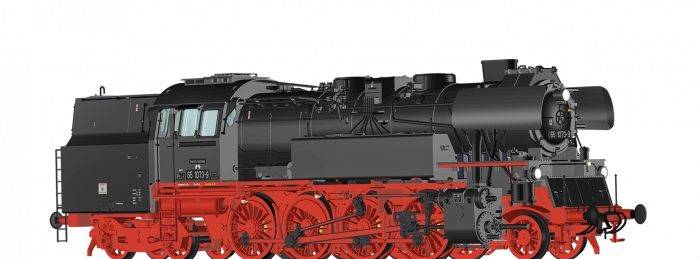

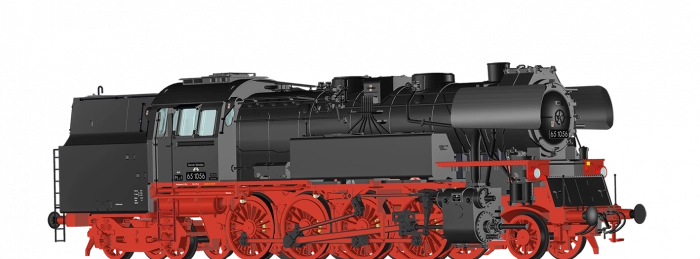

Tender Locomotive BR 65.10 DR
Road no.: 65 1056; Rbd Dresden; Bw Dresden-Altstadt


Model details
- 65 1056 in condition as of 1965: original chimney; wet steam regulator; old design of feed pipes
- Lights equipped with maintenance-free LEDs
- Light change white/red
- Drive in the boiler for direct view through the cab
- Prepared for sound or with built-in sound
- Engine lighting (Version Digital EXTRA)
- Fire flickering (Version Digital EXTRA)
- Illuminated driver's cab (Version Digital EXTRA)
- New trailing bogie kinematics
- Revised control components
- Revised wheels
- New smoke box door and latch
- Wind deflectors with rounded corners
- Revised mixing preheater
- Coal bunker without step pads
- Revised frame
- Additional detailing in the driver's cab
- Rear water tank variant-specific with and without tool cabinet
Overview of technical functions
 |  |  | |
|---|---|---|---|
| Light change |  | | |
| Fire flickering | | | |
| Driver cabin lighting |  1) 1) | | |
| Engine lighting | | | |
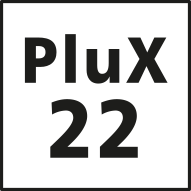
| Digital interface | PluX22 | PluX22 | PluX22 |
| Decoder | | | |
| Sound | | |
1) function only available in digital mode
Info about the original
In 1951, the German Reichsbahn in the GDR began planning a long-term renewal of its aging locomotive fleet. To this end, a construction program was drawn up in 1952 that included seven different new types of steam locomotives. Four types from the program were actually realized. The class 65.10 tank locomotive was developed in the performance class of the former Prussian P 8 and T 18. Their design was based on the two experimental locomotives of the 25 series. Since these in turn were based on a design by the Borsig company, the first two locomotives were still given Borsig factory numbers. Parallel to the test runs of the two prototypes, series production was already underway at the Karl Marx locomotive factory in Babelsberg. This situation made it considerably more difficult to iron out design-related "teething problems,” which could only be gradually remedied during operation. By 1957, a total of 88 locomotives had been built and delivered to the Reichsbahn. They were used particularly frequently during rush hour with short stops between stations, as their excellent acceleration made them ideal for this purpose. The maximum speed was 90 km/h and the service weight was 113 t. All locomotives were initially equipped with a superheated steam regulator, which was gradually replaced by a wet steam regulator from mid-1964 onwards. From 1966 onwards, the angular mixed preheaters were also converted to the well-known DR design and the draft systems were improved to Giesl ejectors with their distinctive flat chimneys. There were hardly any changes to the fleet until 1975. However, between 1976 and 1979, the series was largely taken out of service. Only the three locomotives used for heating purposes, 65 1008, 1049, and 1057, survived, of which 65 1057 is currently undergoing refurbishment to make it operational again.
Further models of the same series