
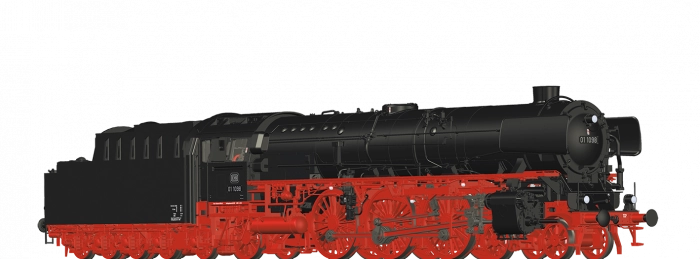

Express Train Locomotive BR 01.10 DB
Road no.: 01 1098; BD Kassel; Bw Kassel




Model details
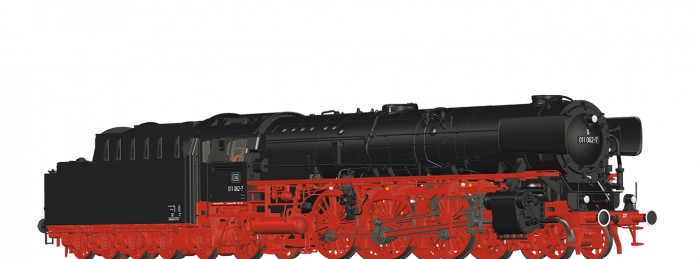
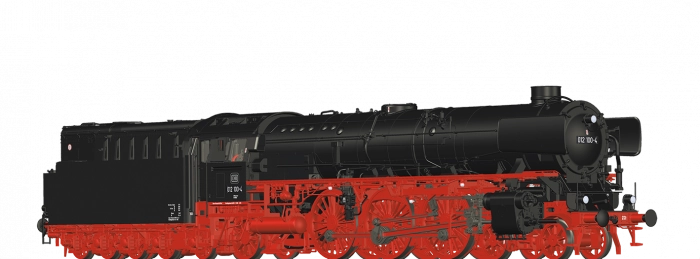
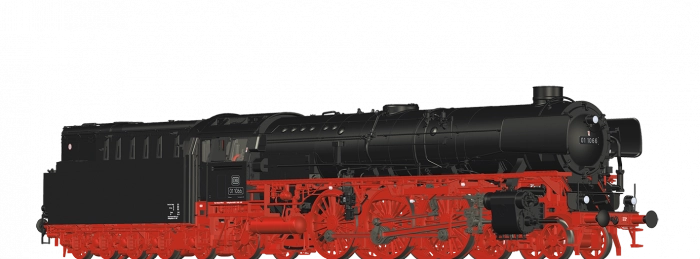
- 01 1098 in its 1962 condition: coal-fired; six sandboxes; old-style cylinders; roller bearings; tall single-piece chimney
- Impact resistant body and chassis
- Perforated underframe in die-cast zinc
- Die-cast zinc spoked wheels
- Fine metal drive and coupling rods
- Detailed replica of the internal engine
- Drive in the tender for optimal driving characteristics
- Close coupling between locomotive and tender
- Standard shaft rear with link guide
- True to original boiler rear wall
- Metal axle bearing
- True to scale axle base
- *Navigable minimum radius: For best driving characteristics of the BR 01.10 steam locomotive we recommend the use on R 420.
Overview of technical functions
 |  |  | |
|---|---|---|---|
| Light change |  | | |
| Fire flickering | | | |
| Driver cabin lighting |  1) 1) | | |
| Engine lighting | | | |
| Smoke generator | can be retrofitted | can be retrofitted | |
| Digital interface | PluX22 | PluX22 | PluX22 |
| Decoder | | | |
| Sound | | |
1) function only available in digital mode
Info about the original
The 01.10 series in its final construction state is certainly one of the most famous German locomotive series. Not least due to its use in the Emsland region until May 31, 1975, and the accompanying end of steam-powered express trains in West Germany, the series also achieved cult status outside Germany. This was preceded by the further development of the 01 series into a 150 km/h three-cylinder express train locomotive, which, in keeping with the spirit of the times, was delivered to the Deutsche Reichsbahn in 1939/40 with streamlined bodywork by Berliner Maschinenbau AG vorm. Schwartzkopff and classified as the 01.10 series. However, due to the war, only 55 of the 204 engines ordered were delivered, 54 of which went to the Deutsche Bundesbahn (DB). The young locomotives, some of which were in a desolate condition after the war, underwent an initial thorough overhaul, during which the streamlined fairing was removed and the boilers were given normal cladding. The maximum speed was reduced to 140 km/h. Shortly thereafter, problems arose with the St47k boiler steel used, which proved to be not resistant to aging. Since the locomotives were urgently needed for DB's express train service, the development of a completely welded replacement boiler was initiated as early as 1952. Just one year later, the 01.10 locomotives were equipped with new high-performance boilers with mixed preheaters. In the following years, there were many further improvements, which were primarily designed to increase efficiency and performance with a view to more reliable operation. The most noticeable external changes are the conversion of the rod bearings to roller bearings and the installation of a main oil firing system in 34 of the 54 locomotives. DB deliberately moved the locomotives to the Bebra, Kassel, and Osnabrück depots in order to be able to cover the demanding traffic on the north-south route and the 01.10 roller runway. With the ongoing electrification of these routes, the final chapter in their operational history began with their relocation (at the end of the 1960s) to Hamburg-Altona and Rheine. The locomotives are now designated as series 011 (coal-fired) and 012 (oil-fired). Express train service with steam locomotives on the DB ended on September 30, 1972, on the Marschbahn line to Sylt and on May 31, 1975, on the Emsland line. On December 6, 1975, 012 066-7 was back under steam as a museum locomotive, making it one of a total of ten engines that have been preserved in museums to this day. The coal-fired 01.10 locomotives from the Kassel depot were regularly used on the Main-Weser Railway in 1962. Unlike the oil-fired locomotives, the coal locomotives retained their tall single-piece chimneys for a very long time. The 01 1098 represents this condition.
Further models of the same series