58227 - Ellok BR 242 Pressnitztalbahn
H0
VI
Pressnitztalbahn
New 2026

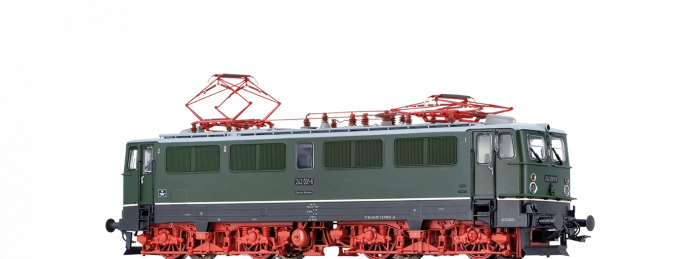
Electric Locomotive BR 242 Pressnitztalbahn

Road no.: 91 80 6142 001-7 / 242 001-6; Rbd Dresden; Bw Dresden
Item no: 58227
motorisierung/system: 1 DC ana b+
Direct current Analogue BASIC+Direct current Analogue BASIC+
loksound: 2 vorbereitet
Prepared for locomotive soundPrepared for locomotive sound
Delivery date: Q4/2026
Item no: 58228
motorisierung/system: 3 DC dig ex
Direct current Digital EXTRADirect current Digital EXTRA
loksound: 1 eingebaut
Integrated locomotive soundIntegrated locomotive sound
decoderdoehlerhaass: 1
Decoder Doehler & HaassDecoder Doehler & Haass
Delivery date: Q4/2026
lüp: 187
187
Length over buffer in mmLength over buffer in mm
radius: 360
Navigable minimum radius 360 mmNavigable minimum radius
(allgemein) schnittstelle: 2 PluX22
PluX22PluX22
(allgemein) haftreifen: 2
2 wheels with fiction tyreswheels with fiction tyres
schwungmasse: 1
Locomotive has flywheel driveLocomotive has flywheel drive
lichtwechsel: 3 Dreilicht-Spitzensignal & zwei rote Schlusslichter in Fahrtrichtung wechselnd
Light changeLight change
(allgemein) innenbeleuchtung (fix oder dyamisch): 2 eingebaut
With interior lightingWith interior lighting
kurzkupplungskinematik: 0
The model has a coupler pocket but no short coupling cinematicThe model has a coupler pocket but no short coupling cinematic
Meaning of the Symbols
motorisierung/system: 1 DC ana b+
Direct current Analogue BASIC+Direct current Analogue BASIC+
loksound: 2 vorbereitet
Prepared for locomotive soundPrepared for locomotive sound
motorisierung/system: 3 DC dig ex
Direct current Digital EXTRADirect current Digital EXTRA
loksound: 1 eingebaut
Integrated locomotive soundIntegrated locomotive sound
decoderdoehlerhaass: 1
Decoder Doehler & HaassDecoder Doehler & Haass
lüp: 187
187
Length over buffer in mmLength over buffer in mm
radius: 360
Navigable minimum radius 360 mmNavigable minimum radius
(allgemein) schnittstelle: 2 PluX22
PluX22PluX22
(allgemein) haftreifen: 2
2 wheels with fiction tyreswheels with fiction tyres
schwungmasse: 1
Locomotive has flywheel driveLocomotive has flywheel drive
lichtwechsel: 3 Dreilicht-Spitzensignal & zwei rote Schlusslichter in Fahrtrichtung wechselnd
Light changeLight change
(allgemein) innenbeleuchtung (fix oder dyamisch): 2 eingebaut
With interior lightingWith interior lighting
kurzkupplungskinematik: 0
The model has a coupler pocket but no short coupling cinematicThe model has a coupler pocket but no short coupling cinematic
Close

Model details

  • Extra mounted handrails in low-material thickness
  • Finely detailed chassis
  • Free-standing roof lines
  • Illuminated driver's cab (Version Digital EXTRA)
  • Prepared for sound or with built-in sound
  • NEM-standard close-coupling
  • Metal wheels and frame
  • Many extra mounted parts
  • Prototypical multipart roof-fittings
  • Metal pantographs
  • Extra mounted windscreen wiper
  • Fine paintwork and painting

Info about the original

Capable of transporting 700-ton express trains up 10 % gradients at 90 km/h – this was the requirement issued by the Technical Central Office of the East German Deutsche Reichsbahn in its specifications for a new electric locomotive. This requirement was based very closely on the specifications for the prototypes of the E10 series under construction at the Deutsche Bundesbahn (West German Federal Railway). In cooperation with Lokomotivbau Elektronisch Werke (LEW), the Deutsche Reichsbahn began developing the universal locomotive E11 in the mid-1950s. As with Deutsche Bahn, however, it soon became clear that there was no getting around the need to derive an independent freight locomotive. The mechanical part of the new series was very much based on the U4 developed by LEW for the Polish State Railways. In addition, the construction principles of the electric locomotives without running axles, which were put into service at BLS and SBB in the 1940s, served as the basis for the development. For the electrical systems, the plan was to acquire West German licences, however this was ultimately not possible and so these systems had to be developed internally. The development work culminated in the two test locomotives E11 001 and 002, which were handed over by LEW to the Deutsche Reichsbahn in 1960 for testing. After completion of the test drives, the knowledge thus gained flowed into the series production of the E11 and E42. The two test locomotives entered regular service and were technically adapted to match the series locomotives by 1966. With the service number 211 001-3, the GDR’s first new electric locomotive has survived to this day and can be seen in the DB Museum in Halle/Saale.

Technical data of the original

  • Year of construction: 1960/61
  • Lenght: 16,26 m
  • Velocity: 120 km/h
  • Service weight: 82,5 t
  • Power: 2500 kW

Further models of the same series
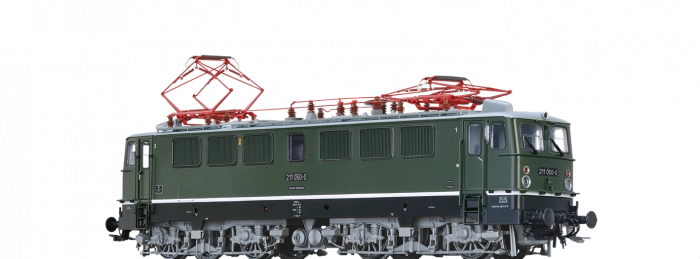
58224 - Ellok BR 211 DR
Electric Locomotive BR 211 DR
50892 - Durchgangszug-Set D 1050 DR, 6er-Set
Through Train Set D 1050 DR, set of 6
43142 - Ellok Reihe Ae477 "Mittelthurgaubahn" Lokoop
Electric Locomotive Serie Ae477 "Mittelthurgaubahn" Lokoop