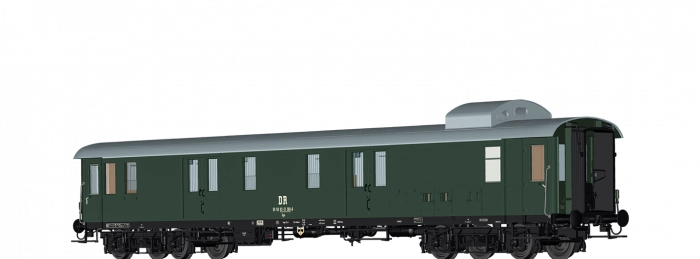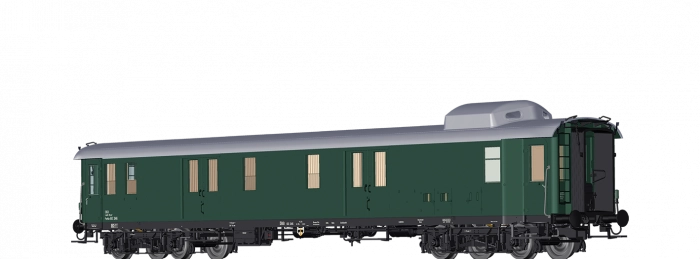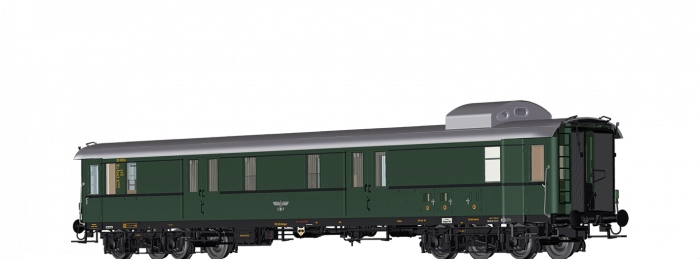

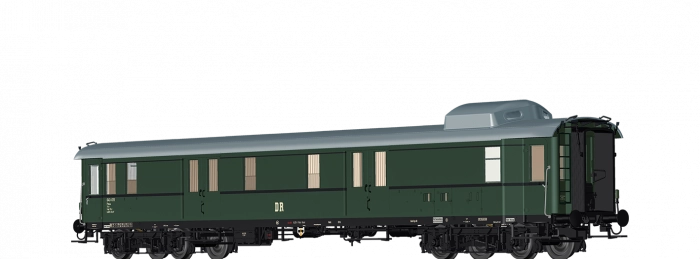


Luggage Car Pw4üe DR
Road no.: 643 015






Model details
- Wheelsets in toe bearing
- True to original axle box cover
- Brake shoes in wheel plane
- Individually mounted axle brake rod
- Multi-part brake system
- True-to-original side walls
- True-to-original roof design
- Complete replica of the vehicle floor
- Interior lighting prepared or built-in
- NEM-standard short-coupling
- Fine paintwork and painting
Downloads

Info about the original
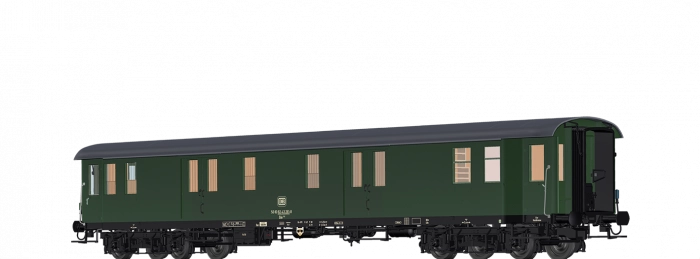
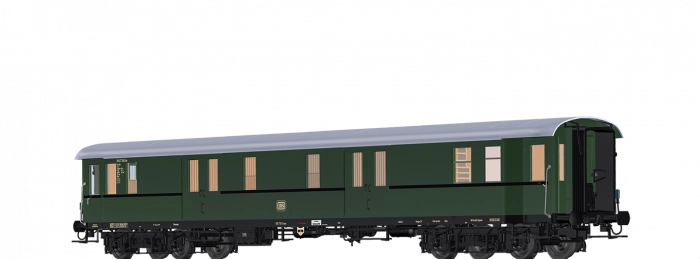
The general state of welding technology enabled the German Reichsbahn (DRB) to completely convert its wagon construction to this technology from 1935 onwards. At the same time, the existing riveted baggage cars were not sufficient to replace the aging regional railway models. Against this background, the DRB commissioned the Reichsbahn Central Office for Mechanical Engineering, together with the wagon manufacturer Linke-Hoffmann-Werke AG, to design a fully welded express train luggage car of the 1935, 1936, and 1936a types. Twenty of the 21.72 m long cars were ordered in the 1935 II vehicle program. Fifty-nine slightly revised cars followed in the 1936 I program. Among them were the 1936a type cars, the first vehicles with a streamlined roof canopy. Orders I and II in 1937 comprised 252 cars that were almost identical to those of the 1936a type. This meant that, from 1940 onwards, the DRB had 331 modern express train baggage cars with a maximum speed of 140 km/h at its disposal for operational purposes. While the 18 cars that went to the Deutsche Reichsbahn underwent virtually no modifications during their later service life, the Deutsche Bundesbahn made several adjustments to over 123 cars. The most noticeable change was certainly the removal of the roof platform on many of the cars from the mid-1960s onwards. To ensure that the train driver could still keep an eye on his train, an additional window was installed on the right-hand side of the vehicle. In addition, the dog compartments with their outward-opening doors were gradually eliminated, as dogs were allowed to travel in the compartments from the 1950s onwards. The modern baggage cars of the m-car series meant that the old type 36 and 37 cars were increasingly replaced by modern types, with the last cars being taken out of service in 1984.
Further models of the same series