
ISSUE APRIL 2026
Welcome to a brand-new issue of the BRAWA News Express!
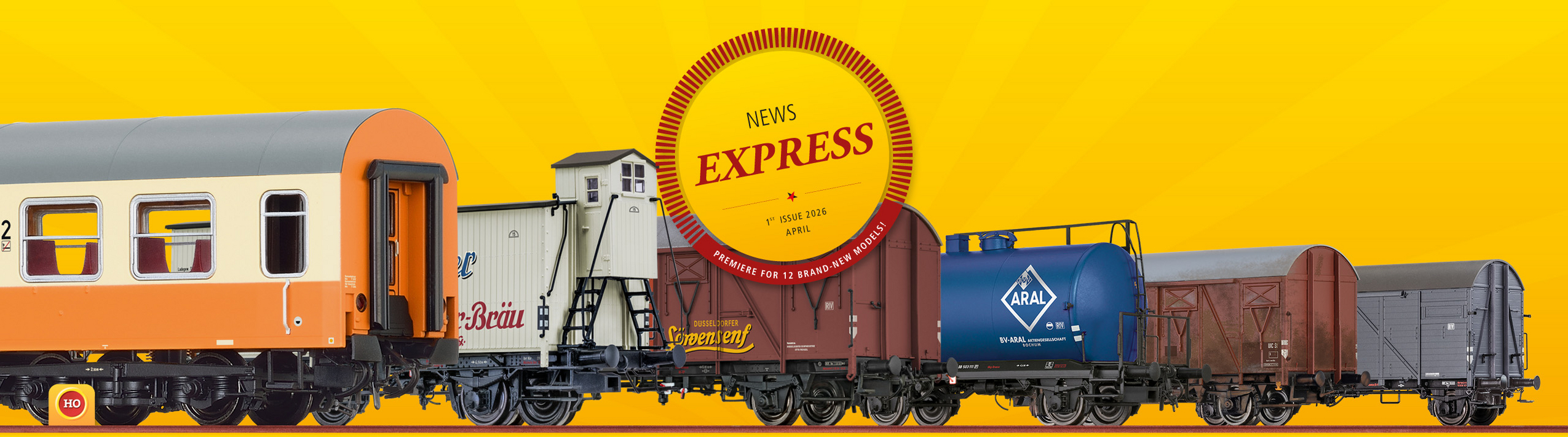
In the actual issue of the News Express, BRAWA presents 12 brand-new models in gauge H0 which are not in the New Items Brochure 2025. The special thing about the News Express is that the models will be delivered to the stores in the near future.
At the same time, we are pleased to introduce the BRAWA Signature Edition – an exclusive new line: a limited series of models available directly from BRAWA, conveniently via our online shop, at our factory outlet, or in person at Intermodellbau in Dortmund.
Further information and details about the models are available on the relevant product pages. You can download the actual issue of the News Express here and on our download page. We hope you enjoy discovering the numerous details.
BACK AGAIN: GREAT ICONS OF THE RAILWAY WORLD
Until 1977, the Raw Halberstadt produced more than 3,000 four-axle Rekowagen for the DR, whose body length was at the time a concession to the plant's structural constraints. Over time, however, these coaches were no longer suitable for commuter and regional services, nor for high-quality operations. As the GDR's wagon industry was fully occupied with export orders, Raw Halberstadt was the only candidate for building the new coach. Since the facilities there had since been expanded, the new vehicle could now make full use of the UIC dimension of 26.4 m.
A prototype was built as early as 1973, followed by a second in 1975. Both were extensively tested in daily service. The nickname "Langer Halberstädter" ("Long One from Halberstadt") quickly caught on among the public – a reference no doubt also connected to the famous sausages produced there. Even during construction, the DR stipulated that the coach should be suitable for "high-quality international operations", which inevitably led to compromises in its design.
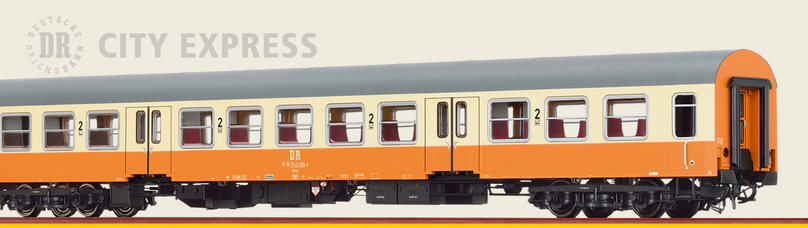
The result was a coach with two entry points and three passenger compartments with a centre aisle. At first glance, the Bmhe resembles the DB's Silberlinge, but is better understood as a further development of the Bghwe coaches incorporating numerous new components. This is also reflected in its weight of 39 tonnes – relatively high, and not quite in line with the "world-class standard" so often aspired to in the GDR. The coaches proved themselves in service and were well received by passengers as a step forward. In keeping with the original specifications, they were initially deployed almost exclusively in express trains on national and international routes, reaching destinations in Czechoslovakia, Poland and West Germany.
From 1976, the DR operated the "City Express" services, providing fast daytime connections between the regional capitals and Berlin. Exceptions to the network included Meiningen, used as an alternative depot for train stabling, and Zwickau as a major industrial centre. Both also served the respective regional government seats of Suhl, Erfurt and Halle, as well as Karl-Marx-Stadt. The trains were made up of 1st and 2nd class coaches of the Y/B 70 type, of which the DR was able to take delivery of 103 units from Waggonbau Bautzen. These had originally been ordered by the CSD but could not be accepted by them.
As the trains and their operating concept quickly gained popularity, the DR required additional coaches in the early 1980s as reinforcement and operational reserve. As a result, 12 Bmhe coaches from the delivery years 1981 and 1982 were painted in the striking ivory and orange livery.
The BRAWA models of these passenger coaches impress with their detailed execution. Key features include faithfully reproduced bogies with separately applied alternator, precisely fitted windows with printed frames, and period-correct interior fittings. Interior lighting is factory-prepared. The models are also equipped with separately applied handrails, steps and underfloor heating. The sprung rubber bellows at the vestibule and close-coupling kinematics ensure prototypical running characteristics.
The models will be available from the 2nd quarter of 2026 at specialist retailers and in the BRAWA Online Shop.
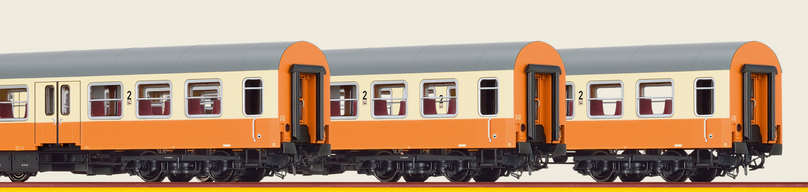
H0 Passenger Coach 2nd class Bmhe „City Express“ DR
Ep. VI, road no. 51 50 21-43 834-3
H0 Passenger Coach 2nd class Bmhe „City Express“ DR
Ep. VI, road no. 51 50 21-43 835-0
H0 Passenger Coach 2nd class Bmhe „City Express“ DR
Ep. VI, road no. 51 50 21-43 838-4
A Celebration for Detail Lovers – Covered Freight Cars of the DRG
Tariff conditions on one hand and technical requirements on the other led all state railway administrations to develop covered freight cars with almost identical dimensions and load capacities. These wagons had a wheelbase of 4.5 m, a length over buffers of 9.3 m for unbraked wagons, a load capacity of 15 t, later 17.5 t, and a floor area of approximately 21 square metres. This type of freight car became the most important and most widely built covered freight car of all time, originally designated with the classification Gm. The most widespread of these state railway wagons was the one based on the Prussian standard drawing IId8, of which no fewer than 47,533 were built. Following the founding of the German State Railway Wagon Association DWV in 1909, the Association Wagon Type A2 was developed from it. This was built from 1911 in a total of an astonishing 121,770 units, making it the most widely built covered freight car in the world. It dominated the image of German freight trains well into the early Epoch 3. Through two world wars, these wagons were scattered across all of Europe – there was hardly a European railway administration that did not operate them at least temporarily.
Lederer-Bräu was a traditional brewery from Nuremberg with roots dating back to the 18th century. It became particularly well known for its Patrizier-Bier, which enjoyed a fine reputation in the Franconia region for its quality and robust flavour. Following the opening of the Bavarian Ludwig Railway in 1835, two barrels of Lederer-Bier were already transported on 11 July 1836 aboard the legendary Adler from Nuremberg to Fürth – making beer one of the very first goods ever carried by German railways.
The BRAWA models are crafted with numerous fine details:
- True to original frame construction
- Fine board joints
- Metal axles and wheelsets
- Multi-part brake system
- Individually mounted signal holder
- Brake blocks in wheel plane
- Perforated car body supports
- Precise paintwork and printing
- Individually mounted axle box cover
The models will be available from specialist retailers and the BRAWA Online Shop from the second quarter of 2026.
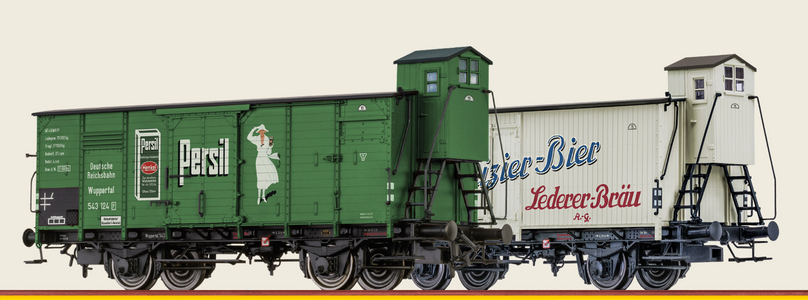
At the beginning of the 20th century, chemists at the Henkel company developed a new self-acting detergent, which was launched under the name "Persil". In 1922, Berlin artist Kurt Heiligenstaedt created the famous "White Lady", who from then on became the defining image of Persil advertising. For the transport of raw materials between the production facilities and Düsseldorf, both tank cars and covered freight cars were used. The latter also served for the dispatch of finished products. To increase brand awareness, a number of G-type association wagons were given a green livery and used to advertise the global brand "Persil".
A Classic of Freight Traffic – with its Characteristic Barrel Roof
Based on the UIC standard wagon Gmhs 53, DB developed a wagon approximately 2 m longer, which otherwise conformed to all UIC specifications in terms of equipment. Unlike its predecessor, it already featured the newly standardised 2 m wide loading door. At the time, the UIC had not yet agreed on a larger standard design – this followed only later in the form of the Glmms 61. As a result, the wagon designated Glm(e)hs 50 was only slightly longer than the large-capacity G-wagons of the pre-war era, which already caused considerable controversy at the time of its construction. Even then, there were calls for a wagon with a loading length of at least 12.5 m, so that the increase in loading space did not go far enough for many, while others felt that the design had strayed too far from UIC specifications. Despite all these circumstances, around 12,000 wagons were built between 1953 and 1958 – until 1954 still with plank walls, thereafter with panel walls. Around a quarter of all wagons received a hand brake, initially still with the characteristic sheet metal brakeman's cab. At least 700 wagons were fitted with an electric heating line to allow them to run in passenger trains carrying express freight. Some wagons were leased on a long-term basis and received advertising liveries from the respective companies. By the mid-1970s, the plank-walled wagons had either been withdrawn or re-equipped with panel walls. From 1965, the Glm(e)hs 50 was redesignated as Gbrs(-v) 245. In 1980, following the removal of most heating lines, the wagons were reclassified as Gos(-uv) 245. During the 1980s, the fleet began to be reduced, although larger numbers were sold to DR. By 1997, 35 wagons remained in service; the last three were retired in 2000.
The BRAWA models of the covered freight car Glmhs 50 are faithfully detailed with numerous features:
- True to scale narrow frame
- Extra mounted steps
- Brake shoes in wheel plane
- Individually mounted brake systems
- Fine rivets and engravings
- Fine paintwork and painting
- NEM-standard short-coupling
The freight cars will be available from specialist retailers from the second quarter of 2026.
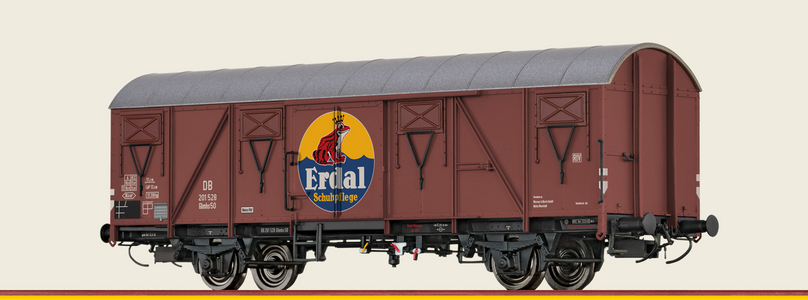
H0 Covered Freight Car Glmhs50 „Erdal“ DB
Ep. III, road no. 201 528
The Erdal brand has stood for reliable shoe care and high quality for many years. With its products, Erdal helps to clean, protect and preserve the shine of shoes. The "Erdal Frog" has been the brand's symbol for over 100 years. While the frog was originally green, in 1919 it received its distinctive royal purple colour. To this day, the well-known Frog King holds great significance for the Mainz-based family company Werner & Mertz. Since 1917, the amphibian has been perched atop the Frog Tower on the company's factory grounds, and is considered one of the oldest monumental illuminated signs in Europe.
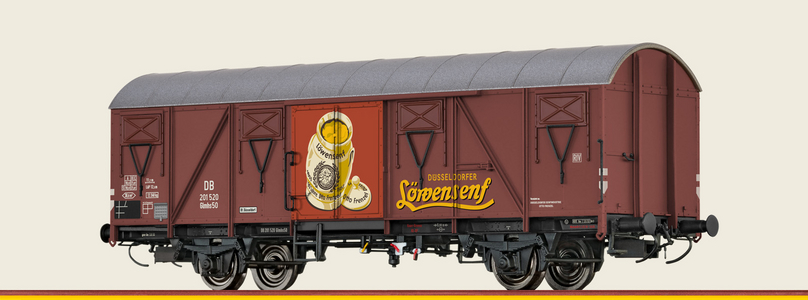
H0 Covered Freight Car Glmhs50 „Löwensenf“ DB
Ep. III, road no. 201 520
Löwensenf is a traditional German mustard manufacturer with roots dating back to the early 20th century. The company was not originally founded on the Rhine – as it is today – but in the then-Lorraine city of Metz. The brand name and its characteristic lion logo are derived from the coat of arms of Düsseldorf, where Löwensenf later found its new home. The brand became particularly famous for its extra-hot Dijon-style mustard, made from brown mustard seeds, which remains a classic to this day.
Fuel for Enthusiasts of the Finest Details
General advances in lightweight construction and welding technology sparked an idea among those responsible at the Reichsbahn: to dispense with the conventional underframe in the design of new tank cars. Instead, the tractive and buffering forces were to be absorbed as far as possible by the tank itself. The widespread use of welding techniques was expected to reduce both material requirements and production costs, while at the same time resulting in more robust vehicles. For this reason, the Uerdingen wagon factory received a contract in 1938 to develop a lightweight tank car with a loading volume of 30 m³.
As early as 1939, the three prototypes were handed over for testing to two private freight car lessors and the state-owned Wirtschaftliche Forschungsgesellschaft. Following a small intermediate series in 1940, series production began in 1941. The largest customer was the Luftwaffe with approximately 2,200 units, followed by the Wifo and numerous smaller companies, bringing the total number of wagons built to around 3,700. In the post-war period, the wagons belonging to the Wifo and Luftwaffe were distributed among other wagon operators in both German states. In the following decades, the wagons were used primarily by larger companies in the mineral oil industry, but also by smaller private firms as well as DB and DR themselves.
The models will be available from specialist retailers and the BRAWA Online Shop from the second quarter of 2026.
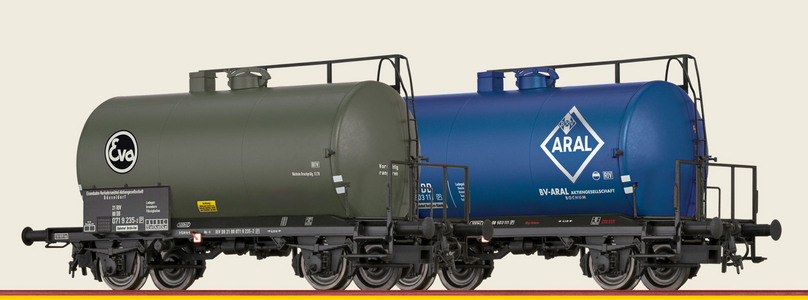
Covered Freight Car Gs210 DB
In 1949, the UIC established a research institute and defined construction principles for freight cars. Based on the ORE designs, European railway administrations developed their own two-axle standard wagons for use within their respective networks. Deutsche Bundesbahn led the way with the first approximately 3,500 wagons based on the preliminary designs, and was already able to introduce the first 2,662 true UIC standard wagons – the Gmm(e)hs 56 – into service from 1957. Similar UIC standard wagons were also produced by SNCF, FS, ÖBB, NS, DSB, MÁV, P.K.P., CFL and SBB.
The BRAWA model of the covered freight car Gs210 is equipped with extra-fitted handrails, a prototype-accurate brake assembly on the wagon floor, NEM-standard short-coupling kinematics, and numerous further details. It will be available from specialist retailers and the BRAWA Online Shop from the second quarter of 2026.
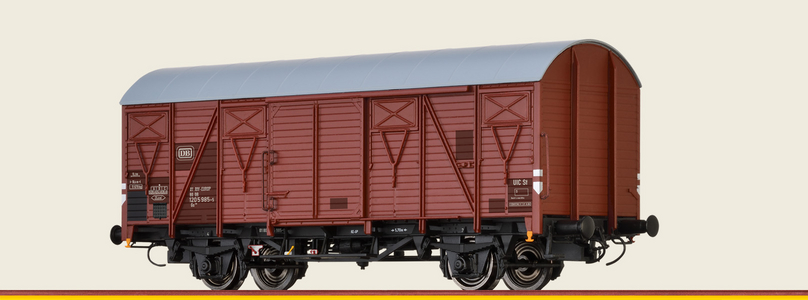
H0 Covered Freight Car Gs210 DB
Ep. IV, road no. 01 80 120 5 985-5
We Make Some Models Look Beautifully Old…
This is once again true dedication to detail: fans with a passion for realism can look forward to a selection of BRAWA models featuring realistic weathering effects. Each edition is strictly limited, and every model is individually weathered by a professional hand. The rust and dirt effects, applied using brush and airbrush techniques, look deceptively real – for even more enjoyment of a model railway that feels straight out of real life.
The BRAWA model will be available from retailers and the BRAWA Online Shop from the second quarter of 2026.
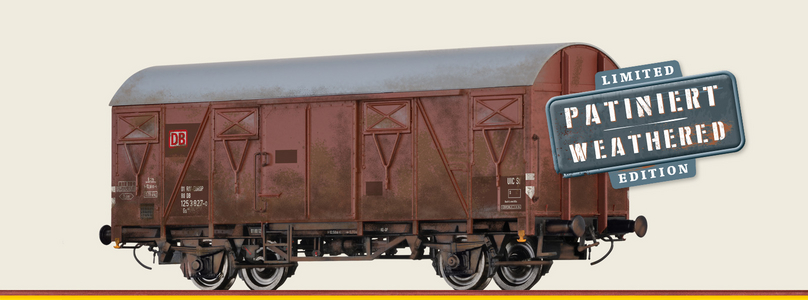
H0 Covered Freight Car Gs212 DB AG, patiniert
Ep. V, road no. 01 80 125 3 827-0
BRAWA Signature Edition – Fascinating Models Direct from the Factory
With the new BRAWA Signature Edition, BRAWA now offers a limited series of models available exclusively direct from BRAWA.
The H0 covered freight car Gmhs35 "Deutz" of the DB makes the debut, equipped with metal axle bearings, different versions of the wagon bodies, a prototype-accurate frame construction, extra-fitted axle box covers, brake shoes at wheel level, extra-fitted handrails, steps and brake assembly, an extra-fitted axle brake linkage, and perforated wagon body supports. The model is now available.
It can be conveniently ordered via the BRAWA Online Shop and will be delivered directly to your door within 4–7 working days, free of charge*. Those who would like to experience the model in person can see it at Intermodellbau in Dortmund (16–19 April 2026, Hall 4, Stand A42) and take it home straight away. There is also the option to purchase the wagon at the BRAWA Factory Outlet in Remshalden on 10 and 11 April 2026.
*For all orders with a value of over €150.
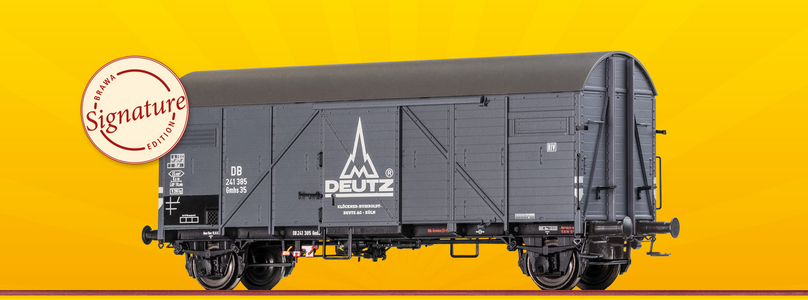
H0 Covered Freight Car Gmhs35 „Deutz“ DB
Ep. III, road no. 241 385
Signature Edition
RPP: Recommended retail price (incl. 19 % VAT), prices are subject to change. Offer valid until sold out. Subject to modifications in design and shape. Colour deviations are possible.
Aral, DB AG, Deutz, Erdal, Eva, Lederer Bräu, Löwensenf, Patrizier-Bier and Persil are registered trademarks.