
ISSUE SEPTEMBER 2026
Welcome to a brand-new issue of the BRAWA News Express!
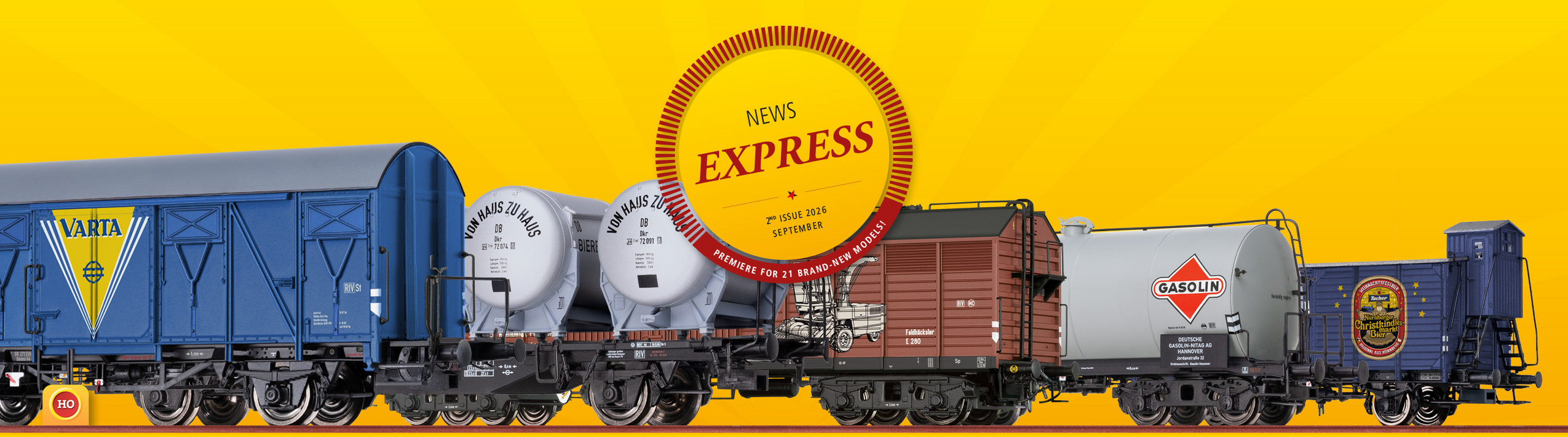
In the September issue of the News Express, BRAWA once again presents 21 brand-new products in H0 scale that aren't yet featured in the 2026 New Items Brochure. The special thing about the News Express is that the models will be delivered to the stores in the near future.
Further information and details about the models are available on the relevant product pages. You can download the actual issue of the News Express here and on our download page. We hope you enjoy discovering the numerous details.
The world's most-built covered freight car – brought to life true to original
Tariff conditions on the one hand and technical conditions on the other resulted in all State railway administrations developing box cars with almost identical dimensions and payloads. These cars had a 4.5 m wheelbase, a length over buffers of 9.3 m for unbraked cars, a payload of 15 t, later 17 t and a floor area of approx. 21 square metres. This type of freight construction became the most important and most built box car; it originally had the type identifier Gm. The most common of these State railway cars, which numbered 47,533, were built according to the Prussian style sheet IId8. After the founding of the Deutscher Staatsbahn Wagen Verband (German state railway car federation) DWV in 1909, the federation car construction type A2 was developed from this. From 1911 a phenomenal total of 121,770 units were built, making it the most heavily produced box car. It dominated the image of the German goods trains until the early days of the third era. These cars were scattered all over Europe by two world wars, there were no European railway administrations where this type of car was not used at least temporarily.
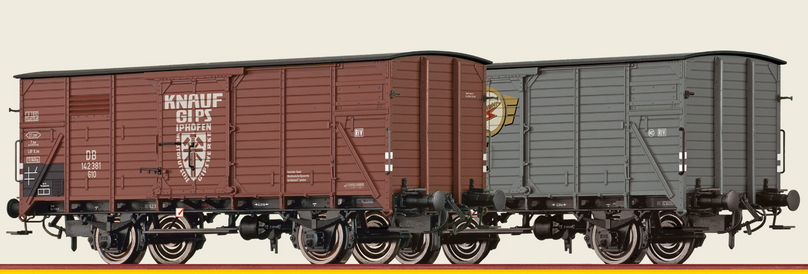
With the September 2026 News Express, BRAWA presents two more Covered Freight Cars of the G10 class, which will be available at specialist retailers starting in Q4 2026. The models feature numerous prototype-accurate details:
- True to original frame construction
- Precise replica of board joints
- Metal wheels and axles
- Multi-part brake system
- Individually mounted signal holder
- Brake blocks in wheel plane
- Perforated car body supports
- Precise paintwork and painting
- Individually mounted axle box cover
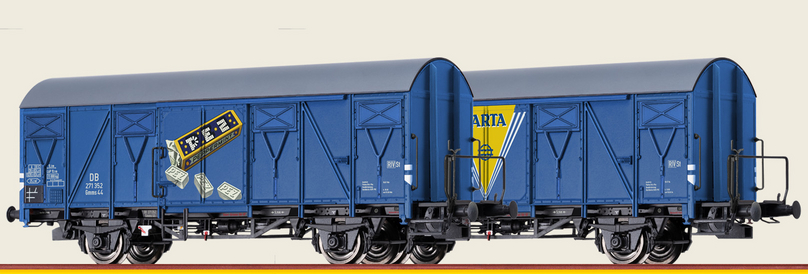
Covered Freight Cars Gmms44 DB
The International Union of Railways (Union internationale des chemins de fer, UIC) founded its own research and development institute (ORE) in 1949, thus laying the foundation for internationally standardised construction principles for goods wagons. The European railway administrations soon developed their own vehicles on the basis of the ORE’s designs and principles for a two-axle standard goods wagon. In accordance with the fundamental idea put forward by the UIC, these were used within the territories of the member administrations to transport goods and freight. The German Federal Railway (Deutsche Bundesbahn) took the first steps via an initial procurement of around 3,500 wagons (as per the preliminary designs) and, with the Gmm(e)hs 56, successfully put the first 2,662 genuine UIC standard wagons into service as early as 1957. Externally, the standardised design was indicated by the inscription RIV St UIC. Other railway administrations, including the SNCF, FS, ÖBB, NS, DSB, MAV, P.K.P., CFL, SBB, acted in a similar way and produced their own versions of the UIC standard wagons. The wagons are all very similar due to this fact, however they also include some country-specific design differences. Since DB had a very high demand for new wagons and there was also a modernisation backlog for older wagon classes, they did not solely rely on brand new UIC St wagons. The wagon types Gmms 44, Gmm(eh)s 60, Gmms 40 and 216 were gradually created via several conversion programmes in which individual parts from older wagons were reused. With over 100,000 units built, these wagon types became synonymous with goods traffic in Europe and were used in almost every goods train from the 1960s to the 1990s.
The BRAWA models of the Covered Freight Cars Gmms44 "PEZ" and "VARTA" from DB will be available at specialist retailers starting in Q4 2026 and feature numerous details such as individually mounted handle bars and axle box covers, a multi-part brake system, metal axle bearings, metal wheels, and brake blocks in wheel plane. The cars are equipped with NEM-standard short-coupling and a brake unit on the car bottom true to original.
A True Multi-Purpose Hauler – Delivering the Finest Details
Derived from the BTms55, which was designed for four pa-containers, the SEAG company built two prototypes of the BTmms58 in 1958. One made of light alloy, the other of ST 52 steel. The resulting car could now be loaded with five pa-containers. This increased the specific load weight, giving the shipper the advantage of being able to pay lower freight rates. The steel prototype proved itself and was further developed to production readiness, so that series production could begin in 1960.
The BRAWA models of the Container Cars are designed true to original with numerous details:
- Brake blocks in wheel plane
- Individually mounted steps and grab irons
- True-to-original three-dimensional frame structure
- Containers of the BRAWA BTmms58 and BT30 can be flexibly interchanged
- Die-cast zinc frame
- Bogie with three-point support
The Container Car BTmms58 DB with Dikr 602 "Von Haus zu Haus" has a body with five removable containers, each bearing an individual operating number.
The Container Cars will be available at specialist retailers starting in Q4 2026.
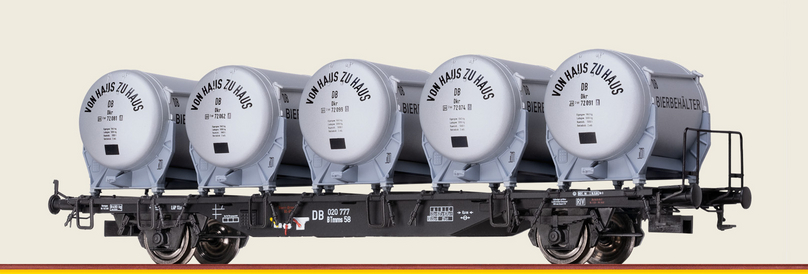
H0 Container Car BTmms58 DB, with Dikr 602 „Von Haus zu Haus“
Ep. III, road no. 020 777
Over the following six years, a total of 2,100 cars of the BTmms58 class were built. For easier handling and loading, each car had at one end either a transition platform positioned over the buffers or a hand-brake platform mounted in front of the car frame. The DB replaced the 35-ton buffers with 59-ton heavy-duty buffers, which were also used from the outset on the cars built from 1964 onward.
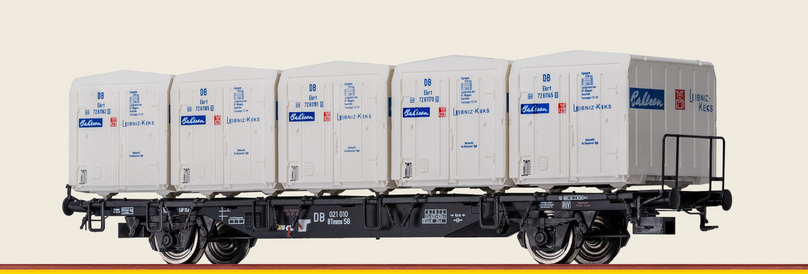
H0 Container Car BTmms58 DB, with Ekrt 212 „Bahlsen“
Ep. III, road no. 021 010
East German Industry on Rails – Moving Forward with Fortschritt
The VEB Kombinat Fortschritt Landmaschinen was one of the most important industrial associations of the German Democratic Republic (GDR) and held central importance for agricultural production. It was founded in 1966 and had its headquarters in Neustadt in Saxony. The Kombinat's goal was to make agriculture more efficient through modern machinery and to secure the population's food supply. Numerous enterprises were united within the Kombinat, developing and producing various agricultural machines. These included combine harvesters, forage harvesters, tractors, and other equipment for soil cultivation and harvesting.
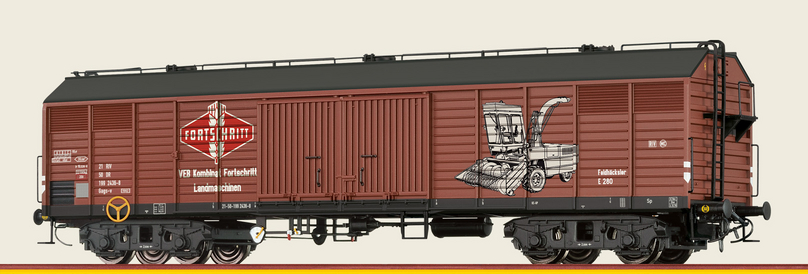
H0 Covered Freight Car Gags-v „Fortschritt“ DR
Ep. IV, road no. 21 50 199 2436-8
The Deutsche Bundesbahn did not procure any four-axle Covered Freight Cars. At the DR, however, these were an important part of the freight car fleet. Building on developments made during the war, various types of four-axle Covered Freight Cars emerged and were procured in large numbers. The final stage of this development was the GGhrsz type, procured from 1966 onward. These cars were later designated Gagmrs-v, then Gags (class code number 1992). This type represented the definitive form of the Deutsche Reichsbahn's four-axle covered cars and was therefore procured in large quantities. The vehicles had a length over buffers of 16.52 m and a load capacity of 57 t. The body was welded together from sheet metal, with a wooden floor. After reunification, these cars were not taken into the joint freight car fleet, though some continued to be used as privately owned cars.
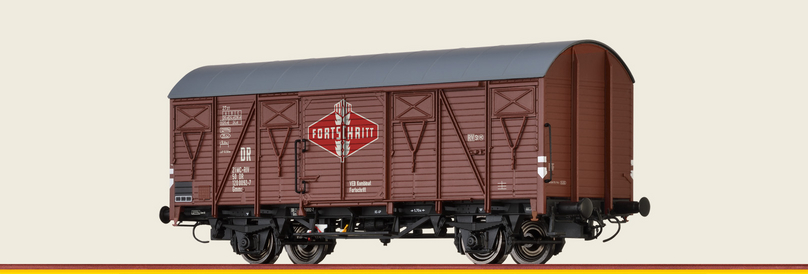
H0 Covered Freight Car Gmms „Fortschritt“ DR
Ep. IV, road no. 21 50 120 0092-7
The Fortschritt brand became particularly well known, exported not only within the GDR but also to many other countries, where it earned recognition. The Kombinat employed tens of thousands of workers and was a major economic factor. After German reunification in 1990, the Kombinat was dissolved as part of the restructuring of the East German economy. The individual enterprises were privatized or closed.
Fuel for Enthusiasts – Finest Details
In 1939/40, the wagon factories Köln-Deutz and Uerdingen each developed a four-axle Tank Car of lightweight construction. The development was driven by the military, aiming to transport crude oil and fuels on a large scale. To conserve steel allocations, lightweight construction principles were exploited to the maximum, which came at the expense of durability. Both manufacturers built cars with self-supporting tanks; Deutz relied primarily on end pieces, while Uerdingen added longitudinal beams made of folded profiles to absorb longitudinal compressive forces. Due to the compact design, there were axle-load/meter-load problems; the tank could not be filled completely everywhere.
The new BRAWA Tank Cars Uerdingen ZZ [P] "Gasolin" from DB and "Minol" from DR will be available at specialist retailers as early as Q3 2026 and are equipped with numerous details:
- Bogie with three-point support
- Individually mounted steps and treads
- Brake blocks in wheel plane
- Individually mounted axle box covers and spring packs
- Fine printing and paintwork
- NEM-standard short-coupling
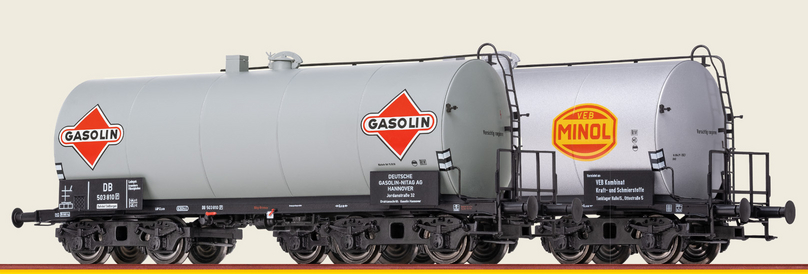
Until 1945, the cars were used by Wifo and oil associations to supply the Wehrmacht. After 1945, European companies built further-developed versions of the car (e.g., Tatra in Prague in 1946). In 1955, SEAG delivered around 500 cars of the Uerdingen type to the U.S. Transportation Corps. Due to war losses and cars remaining with other states, many cars went missing; cars from the western zone ended up with VTG (1951). DR cars remained in the state railway's fleet, leased out to, among others, PCK Schwedt/Oder. The last cars were only retired in the 1990s; for a time, they served as railway service or station cars.
From the Tracks to the Fruit Shelf – Fresh Models for Your Layout
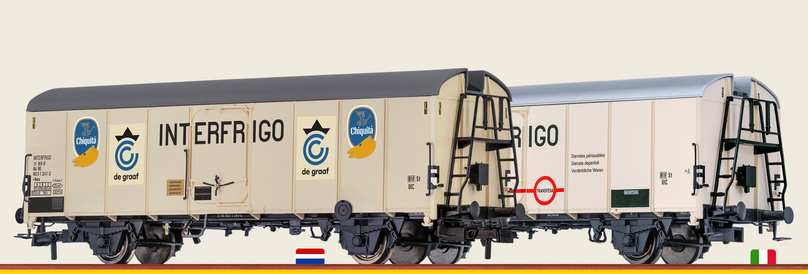
The UIC included two Refrigerator Car types in its proposals for standardized car designs. The Standard 1 became the most-built Refrigerator Car to this day. The state railways of Greece, Morocco, Italy, Switzerland, France, the Netherlands, and Belgium procured examples of the St. 1. Meat companies, breweries, and food chains put this Refrigerator Car into service. In total, around 6,500 examples were built. In the 1960s and 1970s, hardly a freight train existed without this reliable car. Via the end platforms, the ice chambers could be loaded by hand with ice bars.
Of the 6,500 examples of the Standard 1 Refrigerator Car, FS Italia accounted for the lion's share with more than 3,500 units. Even when the St. 1 cars had long since been retired by the other railway administrations, they continued to carry fruit, vegetables, and flowers under the "Italian flag" across the Alps into cool Central Europe.
The two BRAWA models are designed true to original with many details, such as a multi-part brake system, bogie with three-point support, wheelsets with pointed bearings, individually mounted railings, and NEM-standard short-coupling. They will be available at specialist retailers starting in Q4 2026.
For Super Fuel – Super Detailed
The Tank Cars of the Zas type are four-axle mineral oil tank cars that were imported from France in the early 1970s as part of a compensation deal arranged by the GDR's Ministry of Foreign Trade. They were used by the DR, served to transport light mineral oils such as gasoline and diesel, and were later partly used as water cars in construction train service. The BRAWA model stands out with numerous details, such as delicate railings, etched walkway grating, a separately mounted brake system, precise printing and paintwork, brake blocks in wheel plane, and a finely detailed Y-25 bogie. Delivery to specialist retailers will take place in Q4 2026.
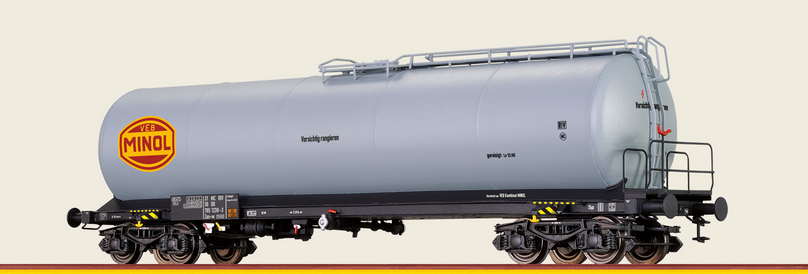
H0 Tank Car 4-axle Zas-w „Minol“ DR
Ep. IV, road no. 31 50 785 1238-3
Finely Detailed Strut Bracing – An Impressive History
The railway has always been a means of transport for large and heavy loads. It therefore made sense that, following various earlier designs, the K.P.E.V. dedicated itself from around 1910 onward to developing rail cars with greater load capacity. In line with the demand of the time, a type of rail car was developed, designed for a load length of 18 m and a load weight of up to 35 t. In various production batches, the K.P.E.V. and later the DRG commissioned a total of approximately 2,650 units of the SSlm rail car, designed according to standard drawing Ce 168, between 1912 and 1928. Characteristic of the rail cars of that era were the finely detailed strut bracing and the perforated sheet-metal car floor. While most cars were initially delivered equipped only with a hand brake, deliveries to the DRB were already fitted at the factory with a Kunze-Knorr freight train air brake. Over the years, many cars of an older build date were retrofitted with this system. The fleet size fluctuated over the years: reparations payments to France, Belgium, and Poland already reduced the overall fleet after the First World War. In the early 1950s, the two German state railways together still had a fleet of around 1,000 SSlm 16 / SSlu cars. Further retirements steadily reduced the number of operational cars, so that the last cars of this type were withdrawn from service in the 1970s.
The BRAWA model of the Heavy Duty Freight Car SSlm 16 is designed true to original with numerous details:
- Brake blocks in wheel plane
- NEM-standard short-coupling
- Die-cast zinc floor
- Insertable stakes, individually enclosed
- Extra mounted steps and handrails
- Metal wheels
- Finely detailed chassis
- Extra mounted axle brake rod
- Individually mounted toe bearing
- Delivery without load
The Heavy Duty Freight Car SSlm 16 DB will be available at specialist retailers starting in Q4 2026.
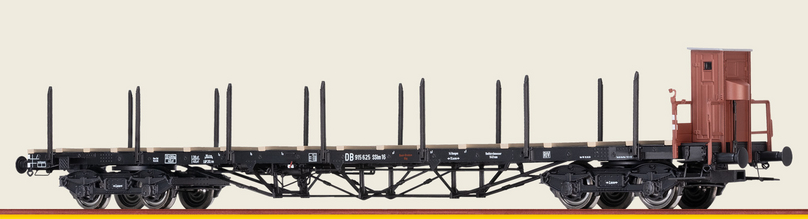
H0 Heavy Duty Freight SSlm 16 DB
Ep. III, road no. 915 625
Covered Two-Axle Car – Always Perfectly Loaded
By the middle of the 1960s, DB procured numerous special wagons with a sliding roof and sliding walls. However, examinations proved that, in many cases, it was possible to forego the opening roof and that an optimized access from the side was sufficient for the majority of cargoes. Consequently, the Hbis 299 which was still initially called the Klmmgs was built from 1966 onwards. To a large extent, the design corresponded to the previously built Tbis 869 sliding roof wagons; the accessibility to the corner was primarily improved. The centre column only had a width of 320 mm; this width amounted to 1000 mm on the sliding roof wagons. The wagons proved themselves in operation and were accepted by the loaders. 2,950 units had already been built by 1970 and the maximum quantity of 8,444 units was reached in 1975.
The BRAWA model is equipped with brake blocks in wheel plane, an extra mounted brake system, individually mounted steps and treads, a true-to-original three-dimensional frame structure, and numerous further details. Delivery to specialist retailers will take place as early as Q3 2026.
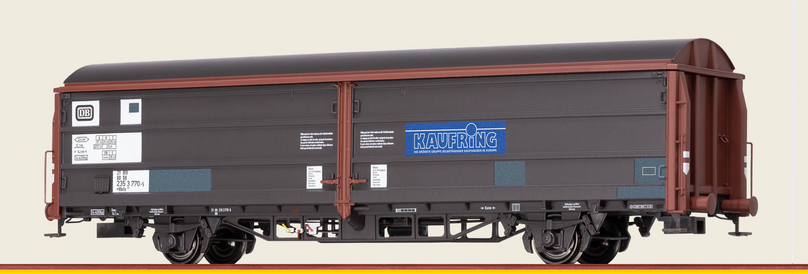
H0 Sliding Wall Car Hbils299 „Kaufring“ DB
Ep. IV, road no. 21 80 235 3 770-5
From Bulk Goods Car to Wood-Waste Specialist
DB AG took over approximately 680 open freight cars of the 5965 type from the former DR. The DR's open freight cars received the type number 070 at DB AG. They were initially used unchanged. Since the dimensions of the car body met UIC specifications, this was possible without any issues. Later, the majority of these cars were converted into wood-chip cars.
The BRAWA model is equipped with numerous details and will be delivered to specialist retailers in Q4 2026.
- Metal axle bearings
- Bogie with three-point support
- Multi-part brake system
- Brake blocks in wheel plane
- Extra mounted axle box covers
- Precise paintwork and painting
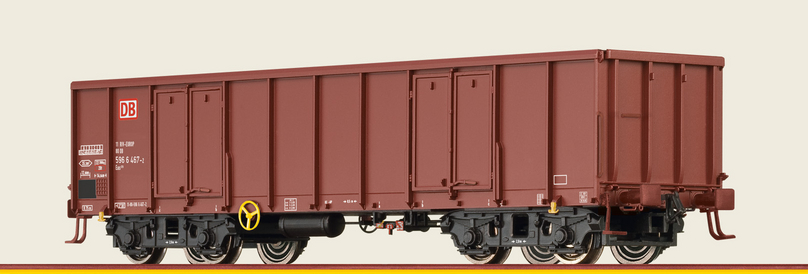
H0 Open Freight Car Eas070 DB AG
Ep. V, road no. 11 80 596 6 467-2
We Make Some Models Look Beautifully Old…
This is once again true dedication to detail: fans with a passion for realism can look forward to a selection of BRAWA models featuring realistic weathering effects. Each edition is strictly limited, and every model is individually weathered by a professional hand. The rust and dirt effects, applied using brush and airbrush techniques, look deceptively real – for even more enjoyment of a model railway that feels straight out of real life.
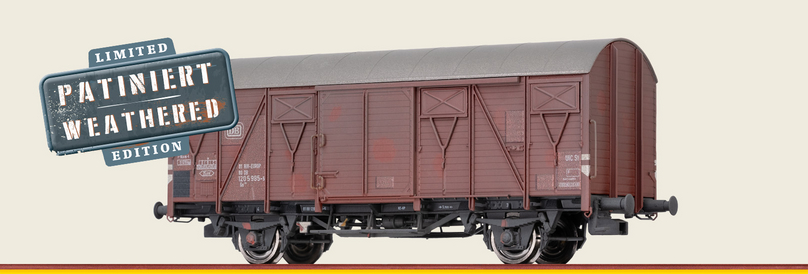
H0 Covered Freight Car Gs219 DB
Weathered model, Ep. IV, road no. 01 80 120 5 985-5
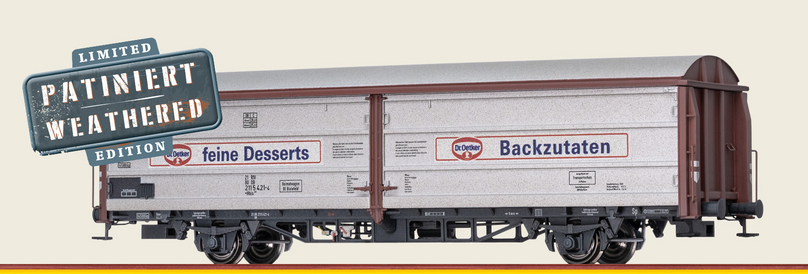
H0 Sliding Wall Car Hbis299 „Dr. Oetker“ DB
Weathered model, Ep. IV, road no. 21 80 211 5 421-4
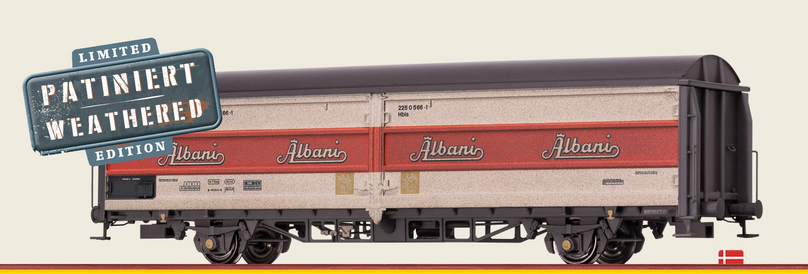
H0 Sliding Wall Car Hbis „Albani“ DSB
Weathered model, Ep. IV, road no. 25 86 225 0 566-1
New Model of the BRAWA Signature Edition
With the BRAWA Signature Edition, BRAWA offers a limited series of models available exclusively direct from BRAWA. After debuting with the Covered Freight Car Gmhs35 "Deutz" DB, the series continues with the H0 Covered Freight Car Gms "Kärcher" DB.
The history of Alfred Kärcher SE & Co. KG began in 1935, when company founder Alfred Kärcher, with great inventive spirit, developed his first technical solutions. The breakthrough came in the 1950s with the first hot-water high-pressure cleaner, which set new standards in cleaning technology. In the following decades, the company expanded internationally and continuously grew its portfolio. Today, Kärcher stands worldwide for quality, progress, and sustainable cleaning solutions, and is regarded as a leading provider in its industry.
The BRAWA model is equipped with numerous details, such as an extra-fitted axle brake linkage, a prototype-accurate frame construction, extra-fitted handrails, steps and brake assembly, as well as precise paintwork and painting. The model is now available.
It can be conveniently ordered via the BRAWA Online Shop and will be delivered directly to your door within 4–7 working days, free of charge*. Those who would like to experience the model in person can see it at Faszination Modellbau in Friedrichshafen (30 October – 1 November 2026) and take it home straight away. There is also the option to purchase the wagon at the BRAWA Factory Outlet in Remshalden, which takes place on a total of four weekends from September to December.
* For all orders with a value of over €150.
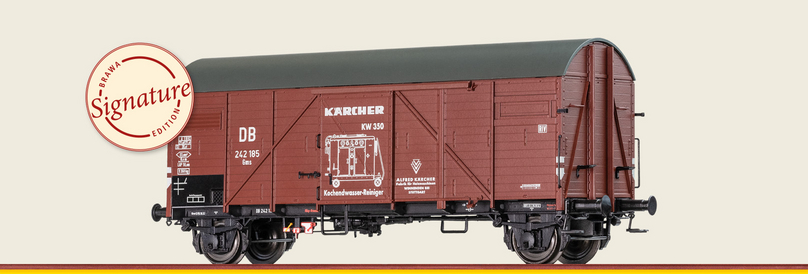
H0 Covered Freight Car Gms „Kärcher“ DB
Signature Edition, Ep. III, road no. 242 185
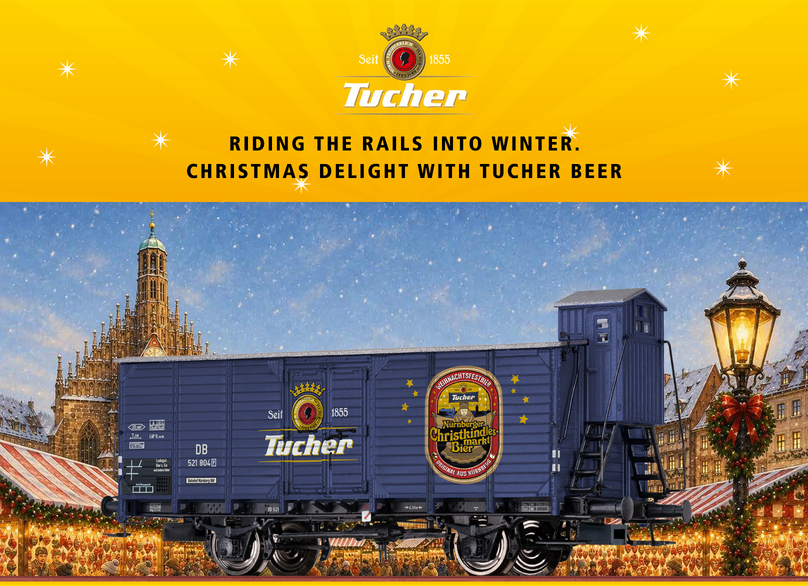
Limited Special Model "Christmas 2026"
The history of Tucher beer is closely tied to Nuremberg's rich brewing tradition, whose roots go back to the year 1672. The Tucher brand, as it is known today, has existed since 1855 and combines this historical heritage with modern brewing craftsmanship. Named after the Nuremberg patrician family Tucher, the brewery stands for Franconian brewing culture, the highest quality, and strong regional ties. The diverse range includes classic beer styles as well as seasonal specialties. A special highlight is the Nuremberg Christkindlesmarkt beer, brewed specifically for the Advent and Christmas season. With its balanced malt note and harmonious flavor, it is a firm tradition of the pre-Christmas season for many visitors to the Christkindlesmarkt, underscoring Tucher's close ties to the city of Nuremberg.
The limited BRAWA special model of the Beer Car "Tucher – Christkindlesmarkt-Bier" DB is designed true to original with numerous details:
- True to original frame construction
- Precise replica of board joints
- Metal wheels and axles
- Multi-part brake system
- Individually mounted signal holder
- Brake blocks in wheel plane
- Perforated car body supports
- Precise paintwork and painting
- Individually mounted axle box cover
The model will be available from specialist dealers from the fourth quarter of 2026. It will be released as a limited edition special model – so make sure you secure your personal copy in good time!
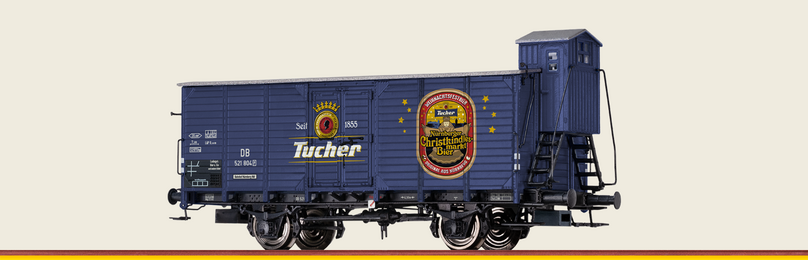
H0 Beer Car „Tucher - Christkindlesmarkt-Bier“ DB
Ep. III, road no. 521 804 [P]
Limited special model
Alpine Charm for Model Railways – The Titlis Cable Car Is Back!
Engelberg, located around 35 kilometers south of Lucerne, is one of the best-known mountain and winter sports resorts in Central Switzerland. One of its biggest attractions is the TITLIS Rotair, which has been carrying visitors up the 3,020-meter-high Titlis since 1992. It was the world's first rotating cable car and is today a Swiss tourist attraction in its own right. The ascent unfolds in several stages, from the green alpine meadows around Engelberg up into the high-alpine glacier world of the Titlis. As the Rotair's cabin slowly rotates a full 360 degrees, it opens up impressive views of glaciers, steep rock faces, and the surrounding mountain scenery. The distinctive cable car is even represented as a model at the Swissminiatur in Melide. For model railway enthusiasts, the spectacular landscape offers plenty of inspiration for recreating challenging alpine routes and striking mountain panoramas. The BRAWA model of the Titlis cable car is now available again at specialist retailers.
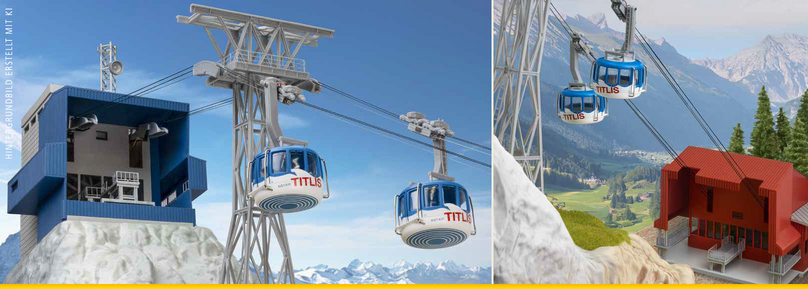
H0 Titlis Cable Car
Building set for the mountain and valley station, 2 illuminated gondolas, 1 middle mast, 1 hauling and bearer cable, Electronic operation (gondola speed can be regulated)
Gift box with building kit (package without figures)
RPP: Recommended retail price (incl. 19 % VAT), prices are subject to change. Offer valid until sold out. Subject to modifications in design and shape. Colour deviations are possible.
Albani, Bahlsen, Dr. Oetker, DSB, Fortschritt, FS, Gasolin, Interfrigo, Kaufring, Kärcher, Knauf Gips, Minol, NS, PEZ, Simson, Titlis Rotair, Tucher, VARTA and Von Haus zu Haus are registered trademarks.